It's Your Time To Travel to Ethiopia Book Your Tour

Let’s About Us

About Ethiopia

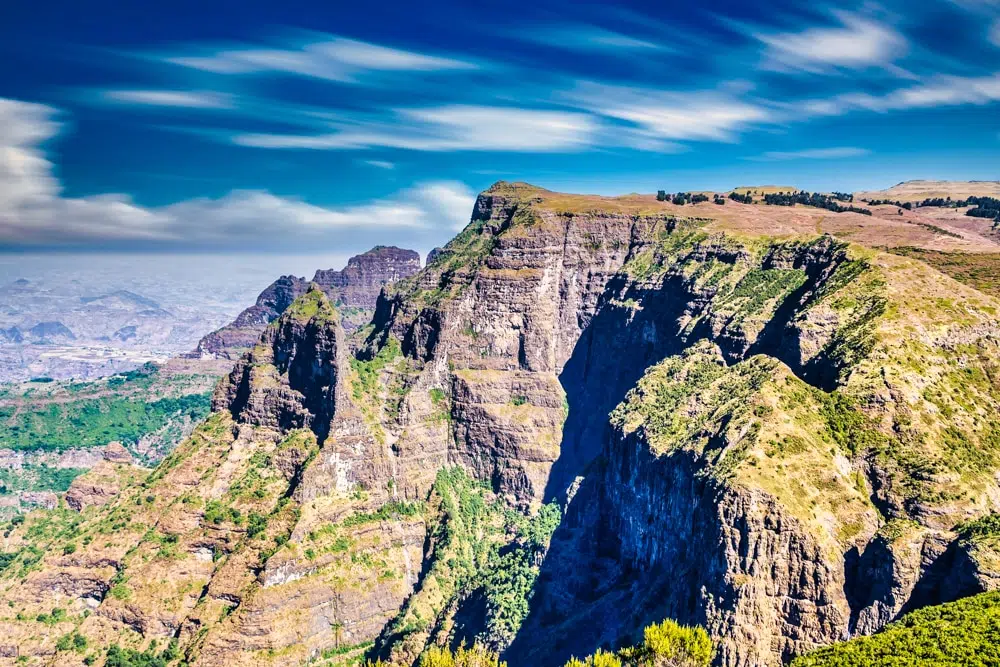
Ethiopia has astonishing landscapes, ranging from the flat-topped Simien Mountains of the north to the otherworldly multicoloured salt flats and lava lake of the Erta Ale volcano in the Danakil Depression; rich flora and fauna and ancient cultures, including the city of Axum (one of the oldest continuously inhabited places in Africa), the rock-hewn churches of Lalibela and Africa’s oldest mosque, Nejashi. It also has one of the continent’s fastest-growing economies, with booming cities and a young population. For all this, it is yet to attract large numbers of tourists, and visitors can often find themselves alone in this amazing country. Ethiopia’s unique cultural heritage, rich history and remarkable biodiversity are also reflected in a tally of nine UNESCO World Heritage Sites – more than any other country in Africa

  • The country is huge and more than four times the size of the UK, and with roads in various stages of construction and repair, full day drives are not uncommon. But these long drives really allow you to appreciate the changes in scenery; anyone venturing south will be traversing the Rift Valley, with its surprisingly lush lakes and astounding views across hills, valleys, escarpment and forest. It also provides the perfect excuse to stop in little towns for a reviving cup of coffee

T R A V E L . A G E N C Y . E S T - 2 0 2 4 .
2.5
k +

Tours
Success

Image
banner-img
Savings worldwide

50% Off

For Your First Book

Book Now

Ethiopian History

It would be impossible to give a full account of Ethiopian history here, but here are a few snippets to whet your appetite.Independent for three millennia, Ethiopia has a long and complex history, in which it is sometimes difficult to distinguish fact from legend. Some of the world’s most ancient hominid skeletons were found in Ethiopia – the most famous of them being Lucy, who lived here 3.2 million years ago. Known locally as Dinkinesh, meaning "you are special", she is now preserved in Addis Ababa’s National Museum. The first Homo sapiens are also thought to have emerged from Ethiopia around 160,000 years ago.

Ethiopia was named by the Greeks and translates literally as “Land of the burnt faces”. The term used to be applied to a wide area of sub-Saharan Africa (note the map from 1710 at the top of this page). Legend has it that the Ark of the Covenant was brought into Ethiopia almost 3,000 years ago by Menelik I, who was the son of King Solomon and the Queen of Sheba of Ethiopia. The Ark of the Covenant is now said to rest in St. Mary of Zion Church in Axum, Northern Ethiopia.

From around the first century to the eighth century AD, the Axumite kingdom was one of the most powerful in the world. The Ethiopian highlands were uniquely placed as the cultural meeting point of ancient Arabia, Africa and the Mediterranean. The Axumite Empire covered much of Eastern Africa and controlled trade routes through the Red Sea and Indian Ocean – shipping routes vital for silk and spice traders.

In the 4th century AD, Ethiopia became one of the first countries to adopt Christianity, and the first to build a Christian church on African soil. Today, around 60% of the population are Ethiopian Orthodox Christians.

Africa’s first Muslim migrants settled in Ethiopia after Mohammed sent them there to avoid persecution in Mecca. The walled city of Harar, in eastern Ethiopia, is now considered to be Islam’s fourth most important city. It is a UNESCO World Heritage Site, and it contains 82 mosques.

Since Menelik I, Ethiopia has had 255 Emperors, the last of which was Ras (prince) Tafari, crowned Emperor Haile Selassie in 1930. He reigned until 1974, when he was arrested by the military. Imperial rule in Ethiopia was officially abolished in March 1975.

Haile Selassie is considered a messiah by the Rastafarian community, who named themselves after him. Although he strongly denied any such godly association, in 1948, Haile Selassie donated land in Shashemene to Rastafarians and other Afro-Caribbeans who wished to return to Africa. There is now a community of about 800 Rastafarians living there today.

Ethiopia FAQs

Ethiopia is, in general, a very safe country for travelers, the only exceptions being some border regions. We always keep up to date with safety and security issues in country and advise that you also check the latest Foreign Office travel advice or equivalent service from your home country, before departure.

You can visit Ethiopia at any time of the year, although most visitors come between October and March, when the climate is generally dry and warm. There are wide variations in temperature, rainfall and seasons across the country though. Road improvements mean the rainy seasons now have little impact on travel in the north of the country, and if you're not adverse to a bit of rain (generally in the afternoon) you will be rewarded with lush green landscapes and less busy attractions. However, the rainy seasons can make trekking difficult in the Simien mountains between May and September, and in the Bale mountains between August and October. Rain can also make some roads in the Lower Omo Valley impassable during April, May and October. At the other extreme, the Danakil Depression is best avoided from May to September, when temperatures can reach a searing 45°C or higher.

All visitors to Ethiopia (except Kenyan or Djiboutian nationals) require a visa. Citizens of many countries can now apply for an e-visa online, which is the quickest and easiest method. Citizens of the same countries can also obtain a visa on arrival at Bole International Airport in Addis Ababa (but be prepared to queue). A 30 day tourist visa costs US$50, or a 90 day one costs US$70. You will also need a valid passport with at least 6 months remaining validity. Please note that visa on arrival is not available to visitors entering by land borders. For more details, see the Ethiopian Embassy website

The unit of currency in Ethiopia is the birr. This is generally not available outside Ethiopia, but cash can be exchanged in Addis Ababa and other cities. It is advisable to bring US dollars, as the easiest currency to exchange, although Euros and Pounds Sterling are also widely accepted at banks and forex bureaux. Alternatively, if you have an International Visa or Mastercard, you can withdraw local currency from cash machines, but be aware that these are rare outside of major towns. Check up-to-date exchange rates.

There are thought to be between 70 and 90 languages spoken across Ethiopia, but the official language of Ethiopia is Amharic. Amharic belongs to the Semitic family of languages, which includes Arabic and Hebrew, but is very different to either of these. It is written in a script of its own which is only used in Ethiopia. A lot of people in the cities speak some English, especially those working in shops and restaurants. In the countryside though, you're unlikely to find people who speak much English. We recommend that you take a pocket phrase book and learn some basics such as common greetings.

Unfortunately, homosexual acts are still considered criminal in Ethiopia and same-sex relationships are completely taboo from both a cultural and religious perspective. Hotels are unlikely to permit same-sex couples to share a double room. However, most travellers do not encounter any problems, provided they are discrete. This is especially the case for female travellers.

Join The Newsletter

To receive our best monthly deals

vector1 vector2